Category — w. Most Recent Stuff
The “E” Ticket Ride and its Discontents, Continued
For the first page of this article, click here.
NEXTGEN–AND BETTER MANAGEMENT–TO THE RESCUE?
The old ticketing system fully disappeared by 1982, and has since been replaced by today’s model of one price admitting guests to all attractions.
The old model disappeared while Epcot was being designed and built. It’s interesting to speculate on how the World Showcase would have worked under the old model of attraction tickets driving revenues. The shift to today’s pricing may be why the show buildings constructed as part of the Germany and Japan pavilions were never filled with rides–the revenue model no longer required these investments.
I noted on the first page of this article that while the old ticket system added costs and complexity, it had some advantages
- For first time visitors, it provided a rough guide to the quality of the attractions
- It encouraged variety–i.e. “A” and “B” Tickets
- It created an additional means of managing demand besides waiting times, and
- It provided a different optic on the short term economic effects of a new ride.
“E” Tickets are not coming back–but it’s not too hard to see how a combination of better management and some of the possibilities of Disney’s NextGen project might bring back some of these “E” Ticket benefits.
THE FUNDAMENTAL PROBLEM AT WALT DISNEY WORLD
Predicting how this might unfold requires defining the problems that are to be solved by better management and by NextGen.
My inference is that the basic issue being addressed is this: Disney World makes the most money when its visitors are the most miserable.
That is, the fixed-cost operating economics means the parks and hotels just print money when they are bursting at the seams. But these times of spectacular crowds and profitability are also the most miserable times for guests to visit.
That’s no way to run a business. Waits are the biggest problem Walt Disney World faces.
The next most important issue is that the Disney World resort hotels have become a key driver of operating economics, but are losing competitiveness in the market–particularly the moderate resorts.
Both of these factor into the third issue, which is that return visitors drive long term returns, but if first time visitors have a miserable time because of lines, and don’t see the value for money of the Disney World hotels, then they will be less likely to come back at all, much less stay in a Disney resort hotel if they do.
NEXTGEN TO THE RESCUE?
There’s only a few ways to reduce crowding.
- One is to increase capacity. Recent changes in the Fantasmic schedule, and experiments with running two afternoon parades a day at the Magic Kingdom, show Disney gets this. See this fascinating recent story from Jim Hill for more on both.
- Second is to limit entrance–e.g. by setting a lower threshold for park closings. This is hard to do for both economic and dissatisfaction reasons–Disney would likely lose more satisfaction from turning more people away than it would gain from the resulting slightly shorter lines.
- Another is to move people from inside to outside the parks. Tom Bricker had a recent post on TouringPlans.com’s blog in which he both speculated about and advocated for installing World of Color at Downtown Disney. Creating a bigger draw to Downtown Disney would reduce evening crowds in the parks. Tom wasn’t sure how to monetize this. But it could be monetized by a purchased FASTPASS, and/or could be reserved to resort hotel guests.
- Another is to strengthen the economic incentives for people to attend during the less-crowded times of the year. Disney does a fair amount of this already with price seasons and discount programs. It could do more.
But the single most effective way to reduce waits would be to better use the capacity in the parks Disney already has.
Ally this with better waiting experiences, avoiding some lines entirely, and having some predictability about your family’s ability to get on to cherished rides–and to me that all adds up to NextGen.
Experienced park-goers know that there’s lots of good rides where waits are often short or non-existent, like Pirates of the Caribbean and The Haunted Mansion, and lots of times of the day when even higher-demand rides have shorter lines–e.g. in the hour after opening, the hour before close, and before and during parades and firework shows.
Shifting demand from the highest-demand rides at their peak waiting times to these rides and/or these times would improve the overall experience of guests.
Moreover, simply knowing when one enters the park that one will get to ride, for example, Splash Mountain and Space Mountain, without having to stand in line for 90 minutes, will also improve the guest experience.
The NextGen idea of making it possible to in effect schedule a FASTPASS for these and other rides well in advance will help with the experience of busier days.
It’s this same scheduling ability that can shift demand to currently less busy times of the day, and to rides with lower capacity utilization.
Families will be more likely to ride Splash Mountain in the first hour of the day or during a parade if they already have a reservation for that time, and to ride the Carousel of Progress, Hall of the Presidents, or the Liberty Belle if they have already chosen a pre-set time to experience these attractions.
And this is where the “E” Ticket concept comes back.
I expect Disney to make available for pre-scheduling–what Al Lutz says is now being called internally the “XPass”–many more rides than are currently covered by FASTPASS. (For some of my prior speculation about this, click here; Tom Staggs has since confirmed parts.)
However, my guess is that Disney won’t offer all of these rides at the same “price.”
I expect it to ration Xpasses in some way so that a family each day can reserve only so many of the most popular rides, so many of the next most popular rides, some many of the next most popular, etc.
This will require classing the rides–and what better way than to go back to the “E” Ticket, “D” Ticket, etc. labeling?
I also expect that the amount of Xpasses available will vary by hotel type–families at deluxes will be able to reserve more Xpasses per person per day than families at the values.
This is one of the ways that Disney can add value to its hotels in general, and to balance out demand among hotel types. For example, it can vary the number of Xpasses available to guests at moderate resorts until the value for money of these hotels is appropriately competitive.
THE ROLE OF BETTER MANAGEMENT
I’ve been working lately in my real job on the philosophical issue related to all of this–getting paid for the value you create, rather than getting paid for an incidental revenue event that happens to be the traditional way of doing things.
The way Disney monetizes the parks–tickets, hotel bookings, food and souvenir sales, etc.–aren’t directly tied to the value it creates.
This is common in many businesses, but it raises a basic philosophical question: are you trying to maximize your economic return while not crossing a minimum level of guest satisfaction, or are you trying to maximize guest satisfaction without going below a minimum level of return on capital?
If you are doing the first–and Disney seems to have been focused on the first for most of the last 25 years or so–the tendency is to look at immediate revenue drivers and short-term operating returns.
If you look at the latter, you focus more on guest satisfaction, on improving the overall experience, and on longer term returns.
I’ve seen some indications lately that Disney is shifting more towards the second approach.
You can see a bit of this in a recent Harvard Business Review interview with Bob Iger. While discussing the issue of the pressure to generate quarterly results, he notes that while it’s hard, “we’re really trying not to run the company on the basis of short term analysis.”
But actions are more important than words. Actions that encourage me range from Disney’s current re-fashioning of Disney California Adventure to what it’s doing right now with Fantasmic and the afternoon parade to, most importantly, the massive NextGen investment.
Don’t get me wrong–all these, if successful, will make Disney money and make it more competitive. Tying access to NextGen benefits to Disney’s hotels would be a particular competitive masterstroke, since Walt Disney World’s competitors have few or no hotels, making Disney’s move very hard to match.
But they may not make money in the short term. The payoff will come from repeat visits generated from better experiences on first visits.
Running a publicly traded company for customer delight rather than maximal shareholder returns is incredibly hard in today’s environment. But as Roger Martin suggests in Fixing the Game, doing so may be the most critical issue that American capitalism faces.
Most of what needs to change will come from board-driven changes in mission, and then building around those a consistent set of values and processes (e.g. the nature of incentives within compensation systems).
Part of it also is making what’s less visible more visible, so that the numbers that get managed match better to the goals the company is pursuing, tying the management processes and short-term goals and metrics better to long-term value creation.
This brings us back to the old days when new rides created new revenues and new profits. A shift created by NextGen to being able to reserve a some “E” Ticket rides in advance may have just this effect.
If access to a new “E” Ticket ride is partly gated by reserving a Disney World resort hotel, and also partly gated by which type of hotel gets reserved (because some hotel types provide more “E” Tickets per day per guest than others), then new rides should generate both more Disney World resort hotel occupancy and a shift in demand for the higher end hotels.
This will provide once more a direct and short-term tie between new “E” Ticket rides and new profits, and thus help incent their development.
At least that’s my thought—what’s yours?
“The “E” Ticket ride is built out of wish-fulfillment of the human ideals of control, beauty, play, order, and especially for the exercise of humanity’s highest imaginative functions” –Freud, Civilization and its Discontents (just slightly paraphrased)
July 25, 2011 1 Comment
February 2012 at Walt Disney World
OVERVIEW: FEBRUARY 2012 AT DISNEY WORLD
This page reviews February 2012 Walt Disney World crowds, prices, deals and discounts, weather, operating hours, adds a few other notes, and ends with week by week summaries.
July 24, 2011 No Comments
Disney World Crowds in 2012: Summer 2012 Crowds
DISNEY WORLD SUMMER CROWDS: THE PRINCIPLES
Walt Disney World summer crowds are governed by two factors:
- Public school summer break calendars, which have start and end dates more varied than you’d think
- The beginning of the peak of the hurricane season, in mid-August
Pretty much all kids are off all of July. As a result, July is the busiest summer month, and during it, the week that includes the 4th of July the busiest week.
Varied dates for when summer breaks begin means June starts well, but builds to high crowd levels later in the month.
August has the opposite pattern, beginning with high crowds, but, through the combination of a trickle turning to a flood of back-to-school dates, and savvy travelers avoiding the peak of the hurricane season, it ends quite un-crowded.
Families that can only visit in the summer (for example, school teachers) should go in early June if they can, or, if their schools are not out then, as late in August as their schedules permit.
2012 PUBLIC SCHOOL SUMMER BREAKS AND THEIR EFFECTS ON WALT DISNEY WORLD CROWDS
The beginnings of summer breaks vary more than most people think.
 The chart to the right illuminates this.
It’s based on data from a weighted sample including more than 125 of the largest relevant US public school districts.
(Click it to enlarge it; when it opens, click it again to enlarge it more.)
In 2012, only about 10% of kids are out before June; 30% are out as of June 2, 2012, 60% as of June 9; the proportion builds slowly over the rest of the month, with essentially all kids off by June 28, 2012.
Few families plan their vacation for their first day out of school, so there’s a lag in the effect of these dates on summer crowds that I can’t precisely quantify.
But the upshot is that early June is not bad.
I rate crowds the week beginning June 2 as 5/moderate-minus, June 9 as 7/moderate-plus, and June 16 begins a string of 9 straight summer weeks rated 9/high or 10/higher.
Because of the variation noted above in when people do go vs. can go, the weeks of June 9 and 16 may be a little better than I’m rating them, but my data sets won’t let me draw that conclusion.
THE PEAK OF THE HURRICANE SEASON AND DISNEY WORLD SUMMER CROWDS
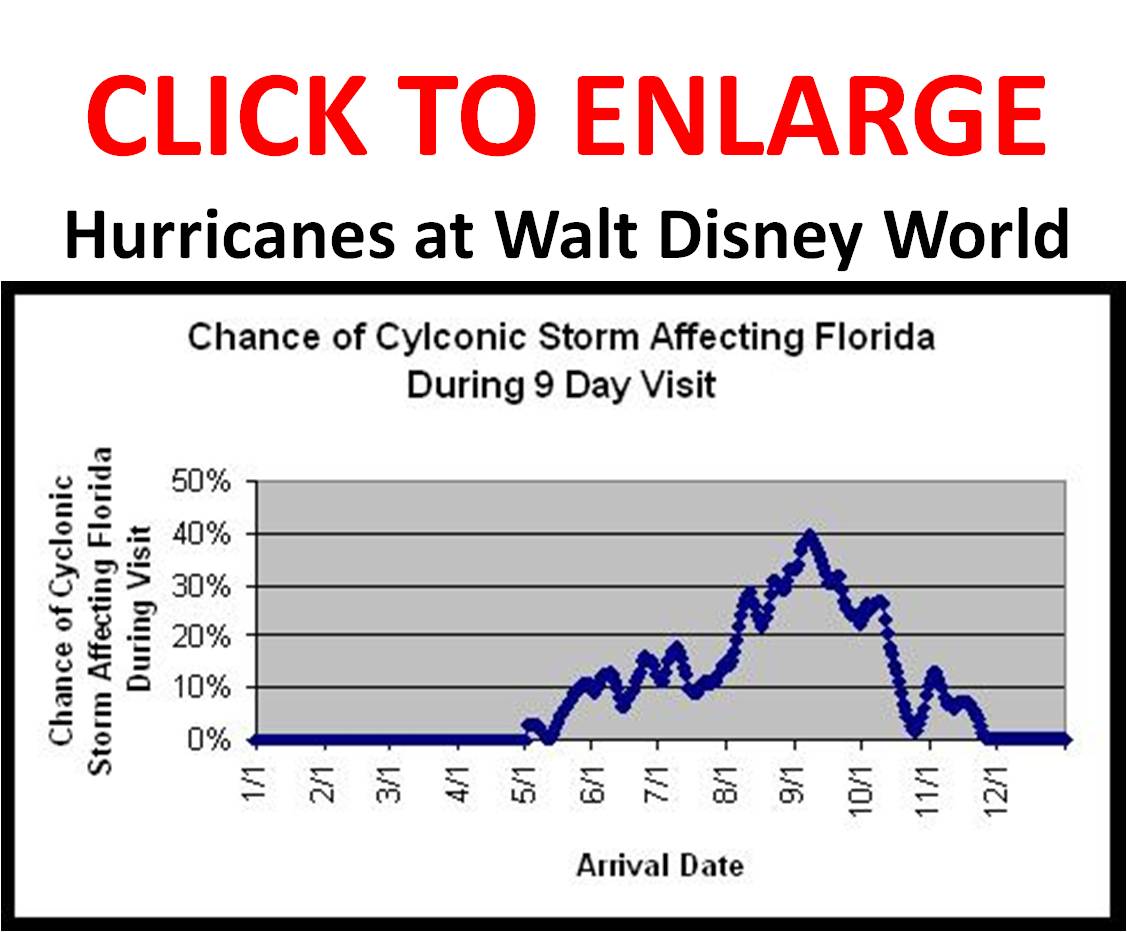 The hurricane season officially runs from June 1 through November.
It peaks, however, from mid-August to early October.
(Click the chart; see also Weather and When to Go to Walt Disney World.)
As a result, August crowds at Walt Disney World are affected not only by the end dates of summer breaks, but also by savvy travelers avoiding this potential weather.
Hurricanes rarely impact a Disney World vacation…but savvy travelers with choices in when they can go commonly avoid this period. (Disney knows this of course, and both drops prices and commonly offers free dining during this period to change the value and risk equation.)
As a result, I rank crowds for the first two weeks of August (arrival dates 8/4 and 8/11/2012) 9/high. The week beginning 8/18 gets a crowd rating of 6/moderate. The week beginning 8/25 gets a crowd rating of 3/low.
July 20, 2011 No Comments
The “E” Ticket Ride and its Discontents
 WHAT’S AN “E” TICKET AT WALT DISNEY WORLD?
I’ve had fun recently writing about “E” Ticket rides at the Magic Kingdom–e.g. here, here, and here.
The phrase “E” Ticket lives today as a metaphor, standing for that which gives rise to a superlative experience.
But it used to be a real thing–the ticket that allowed you on to the newest/best/most popular rides at Disneyland and the Magic Kingdom.
I’ve been noodling a bit lately about the “E” Ticket’s journey from object to metaphor, the negative implications of its physical absence, and the potential of Disney’s NextGen project to bring its absent presence back to concrete reality–though in a different form.
Some other influences on this thinking have been rumors of World of Color coming to Downtown Disney, some light recreational reading I’ve been doing on saving American capitalism from the current model for running publicly-traded companies , and some consulting work I’m preparing to do on recasting physician compensation models so that MDs are paid for the value they create, rather than activity.
In what follows, I’ll pull all this together–and I promise that, as unlikely as it may seem now, it’ll be at least a “C” Ticket experience!
“E” TICKET RIDES YESTERDAY AND TODAY
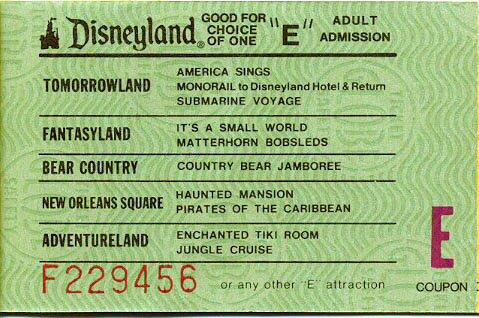
The original price model for Disneyland combined a park admission price with individual ride prices. One paid to enter the park, and paid more for the tickets used to actually gain access to the attractions.
Each ride was classed, and each class had a ticket and associated price. Disneyland began with class “A,” “B,” and “C” tickets, added more expensive “D” tickets at its first major expansion, and even more expensive “E” tickets at its second. The original “E” ticket rides included the Matterhorn and the Monorail.
Tickets were sold both individually (“Dad, I want to ride it again–will you get us some more “E” Tickets?”) and in books that contained varying numbers of the different types– a few “A”s, a few “B”s, etc.
This led to operational complexity–ticket printing, selling and collection–but no one saw it as such, as no one understood there was an alternative.
But in this sea of paper, complexity and labor, there were some advantages.
ADVANTAGES OF THE OLD “E” TICKET SYSTEM
One advantage for first time visitors was that the ticket levels (and associated increasing ticket prices) gave some sense of the relative quality of the attractions. This helped with navigating the park.
Simply, an “E” Ticket was likely to be more fun than a “C” ticket, a “D” Ticket more fun than a “B” ticket, etc.
Many families took the approach of riding all the “E” and “D” attractions, buying extra tickets in addition to their coupon books to do so, but riding only as many “A,” “B” and “C” rides as came in their coupon book.
Disney’s current FASTPASS system plays a bit of this role in marking some exceptional rides today, but is widely misunderstood by first time visitors. Moreover, not all the current “D” and “E” rides are on FASTPASS (at least today–NextGen will likely change that).
Of course, “E” tickets themselves were never perfect guides to distinctive quality–note that the Tiki Room is on the mid-70s “E” Ticket example above, and the rides listed on the first “E” Ticket included not only the Matterhorn and Monorail, but also the Santa Fe & Disneyland Railroad…
The second advantage of the old system was forcing a variety of attraction types. The model of “A” through “E” tickets requires, of course “A” and “B” and “C” attractions. You can still see such at the Magic Kingdom in the vehicles on Main Street, and rides like Astro Orbiter.
While these “A”-“C” rides don’t attract many riders, they add a certain variety and vitality to the parks. The Animal Kingdom is the example of the opposite…pretty much everything there is a “D” or “E” ticket. Part of the point of Joe Rohde’s design for Dinoland U.S.A. was to bring back some of the vitality of a landscape with “A,” “B” and “C” rides.
The third advantage of the old system was providing another way to ration capacity in addition to willingness to wait in lines. Tickets mean that higher demand than capacity at a ride can be solved through increased prices rather than just longer lines–e.g. shifting a ride from a “D” Ticket to an “E” Ticket. Too little demand for a ride can be addressed by lowering prices–shifting a ride from a “C” to a “B” Ticket. Such a ticket system intrinsically does a better job of reducing waits at high-demand rides or filling rides with excess capacity like Carousel of Progress than wait times alone.
But probably the most important advantage of the old system was its impact on how capital and operating budgets were viewed.
The Disney park business model used to be pretty simple.
Adding a new wonderful ride drew on capital and added operating costs to the parks. But doing so also added revenue, as more “E” Tickets would be sold.
The added sales would not be the same as the total rides of the new ride, since there would be some cannibalization of the older “E” Ticket rides. That is, some people would buy no more “E” tickets than they would have without the new ride, and instead just ignore some of the other “E” ticket rides while riding the new one. But other guests would ride both the other “E” tickets and the new one as well, and the upshot was an increase “E” Ticket sales, and thus in revenue that could be pretty directly attributed to the new ride.
Nowadays the business model is more complicated.
Because a single entry price allows access to all of a park’s rides, a new ride in the short term can simply have the appearance of raising operating costs. Invest a ton, and as a result hurt profitability. The response has been to fix profitability when new rides open by eliminating other rides and their associated operating costs.
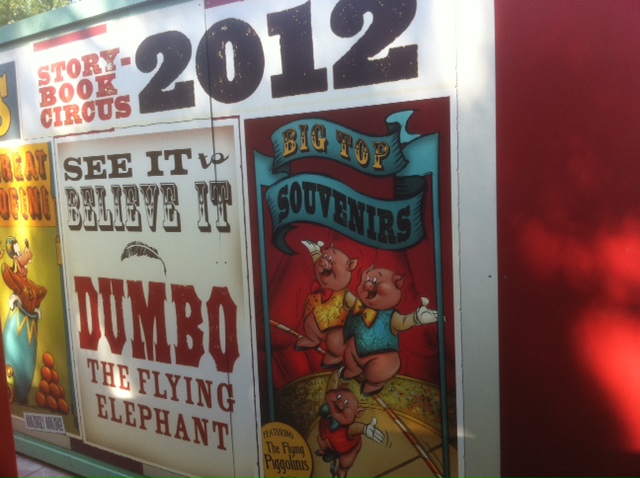 For example, as far as I can tell, the Fantasyland expansion did not need to be put in the footprint of Mickey’s Toontown Fair.
There’s land to the west that could have been used instead.
But putting the expansion on a closed Toontown reduces operating costs both during construction and after the Fantasyland expansion opens, compared to leaving Toontown untouched and open.
Jim Hill–who has covered such economics for a long time–has a fascinating recent story that illuminates the economics of these decisions, but in this example with a positive outcome for guests.
When the American Idol Experience opened at Disney’s Hollywood Studios, productions of Fantasmic were cut back, especially during the slower seasons, to clean up the park’s resulting increased expenses.
This resulted in not only massive guest complaints–Fantasmic is huge favorite–but also crushing crowds at the Studios on Fantasmic days from people without park hoppers.
Interestingly, though, the Fantasmic show spot is not used for any other activities, and has its own snack stand and crew of trinket sellers.
No Fantasmic, no snacks or trinkets sold…and as Jim notes, these generate enough funds to roughly cover the incremental cash costs of a Fantasmic show.
Partly because of recognition of this, more Fantasmic shows have been added to the calendar.
This is the kind of direct visibility between costs and revenues that under a “one price admission to all rides model” is now rare at Walt Disney World.
In the longer term, new “E” Ticket rides revitalize the brand, and pay off from first time and repeat business. Everybody knows this. That’s why this stuff gets built. Everybody also knows what the ridership is of a new ride.
But unlike in the days of priced ride tickets, there’s no easy way to tie that ridership to the revenue accounting, and hence to direct profitability. All that’s inescapably visible are the added operating costs of the ride…and because these are obvious, they tend to be what gets managed. While as always the map is not the terrain, over any short term period the math is what tends to get managed, not the thing itself.
BETTER MANAGEMENT AND NEXTGEN TO THE RESCUE?
This article continues here.
July 19, 2011 No Comments
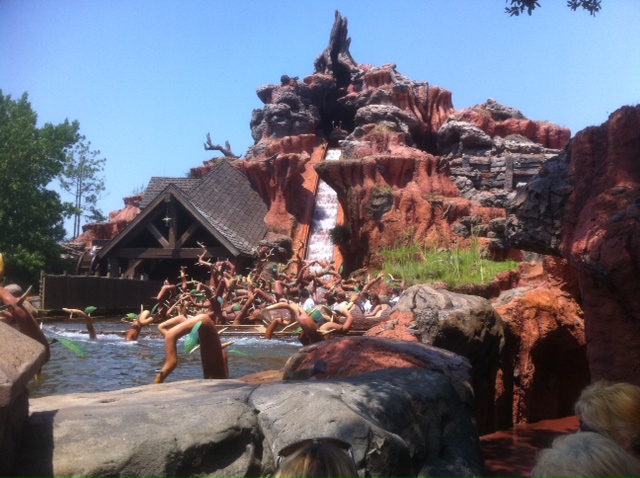
Review: Splash Mountain at the Magic Kingdom
SPLASH MOUNTAIN

I review rides only when they are new or after they have changed, on the theory that first time visitors ought to try them all and hence don’t need reviews.
(For those without the time or energy to try them all, there’s a
comprehensive guide to Disney World rides and attractions here and also a list of Disney World rides that might be skipped here.)
Splash Mountain has had a minor recent change–the addition of lap bars–just enough of a change to give me an excuse to review it…
July 18, 2011 2 Comments
Review: Loews Royal Pacific Resort at Universal Orlando, Continued
(This is the second page of this review. For the first page, click here.)
LOEWS ROYAL PACIFIC RESORT: BEST PLACES TO STAY
The Royal Pacific is laid out like a big Y.
See the not-so-great map below (It’s a photo of a sign; I could not find printed maps to scan…)
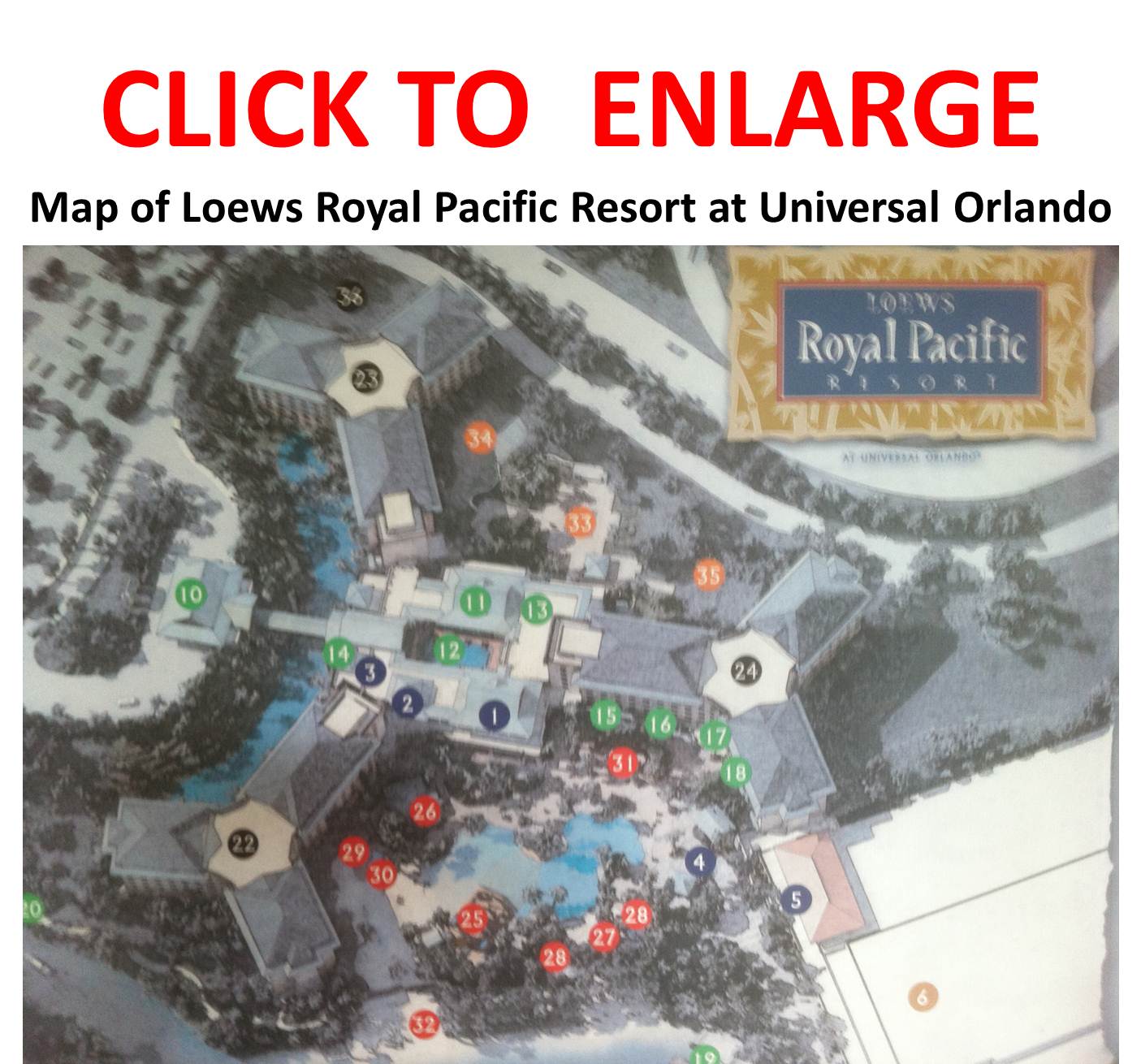
The ends of the Y are three room towers, themselves Y-shaped.
The tower on the upper left–labeled 23, and known as Tower 2 or the Leeward Tower–is the least convenient to the pool and boat docks/walkways to the theme parks.
The other two towers–22 on the lower left, known as Tower 1 or the Windward Tower, and 24 at the right center, known as Tower 3 or the Royal Tower–encircle the pool and are closer to the boat dock and theme park walkway.
The boat dock to the parks is just visible as the green point labeled 19 at the bottom of the map.
The walkway to the parks follows the upper part of the same lagoon (barely visible on the map) the boat dock is located on, and heads leftwards past the Windward Tower (on the map) along the boat canal to Islands of Adventure.
Convenience to the pools, the boat dock and the theme park walkway makes the Windward Tower the best of the three options.
GETTING TO THE THEME PARKS–AND ESPECIALLY THE WIZARDING WORLD OF HARRY POTTER
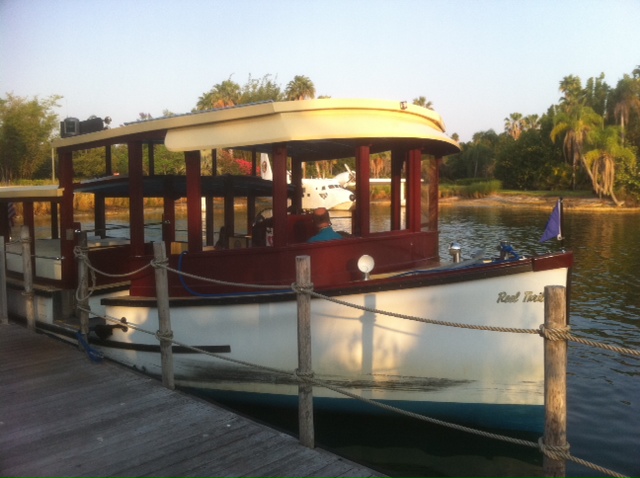 You can take the boat or walk.
The boat is more fun and easier.
For most families, walking is faster unless the boat has no line and is ready to leave when you arrive.
Either way, once you are moving, getting to the entrance to Islands of Adventure takes about 5-10 minutes.
My trip, carefully but not thoughtfully designed to put me first in line for the wand choosing the wizard at Ollivanders, went as follows:
- Walk from my ground floor Leeward Tower room to the boat dock: 4 minutes
- No line for the boat at 7.28a; 4 minute wait for the boat to leave
- 6 minutes to the dock at Universal’s Citywalk, between NASCAR and the Hard Rock, with a very entertaining boat skipper
- Realize at 7.43a that I left my room key locked in my room, so won’t be able to get in for the early admission to the Wizarding World
- By 7.57a I had walked back to the Royal Pacific, gotten a dupe of my room key, and returned to the boat dock
- This time there was a longish line for the boat, but I got on the next (8.01a) departure anyway, was back at the Citywalk dock by 8.06a, and in Hogsmeade by 8.16a
MORE ON THE ROOMS AT THE ROYAL PACIFIC
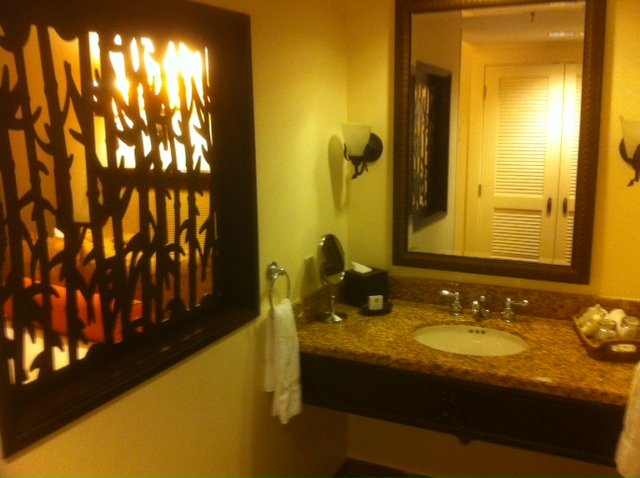 As noted on the first page of this review, Royal Pacific rooms are on the small side and hold four.
As you enter, the split bath will be on one side and the closet and connecting door on the other.
The bath has one sink (this compromise lets the bedroom space be a little bigger) and a semi-screened cutout between the sink area and the bedroom. This cutout will be a negative for most families, as it limits the ability to manage noise and light from the sink area.
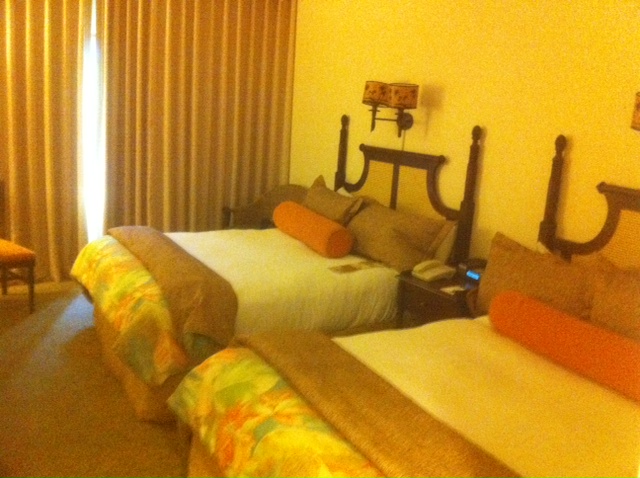 In the bedroom area you’ll find two queens and an upholstered chair on one side.
The other side has a largish round table with two chairs, and a credenza with drawers, a small TV, a mini-bar (but no separate fridge) and a coffee maker.
(You can order a mini-fridge for an additional fee.)
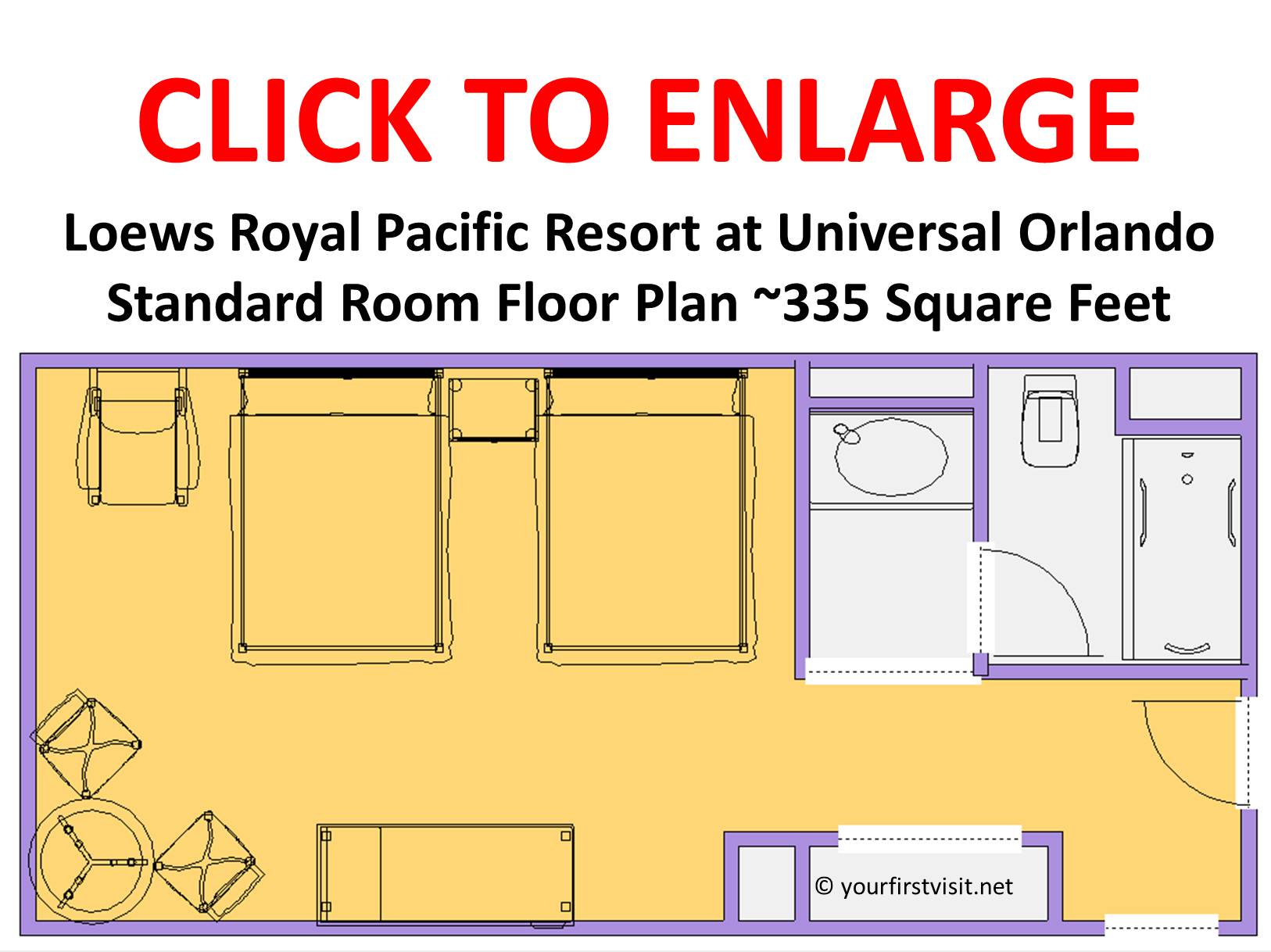 As noted on the first page, there’s no balcony.
These rooms are adequate for a family of four.
There’s enough space, but no more than enough.
The theming of the rooms (and the room towers) is scant; one could be anywhere.
MORE ON THE ROYAL PACIFIC RESORT
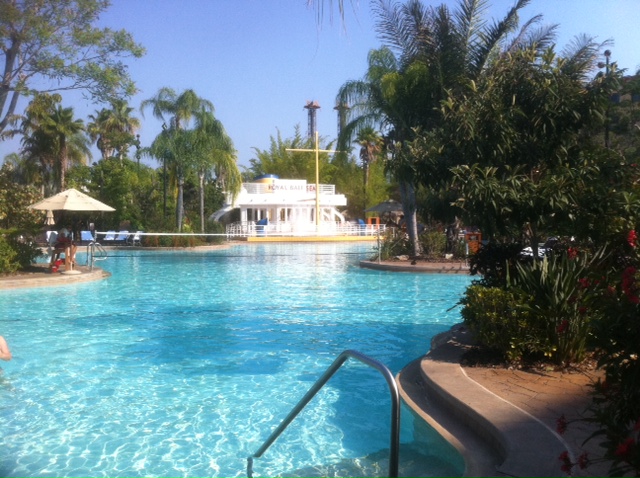 The best overall features of the Royal Pacific are its pool, its general theming, its price, its access to the parks, and all the sit-down dining options it provides.
The pool is particularly a marvel, and in its size, meandering, distinctive areas, and decoration has few peers at Walt Disney World.
My photos of the pool–on this and also on the first page of this review–don’t begin to do it justice.
The Royal Pacific is pet-friendly and takes a European attitude to smoking.
It has price seasons similar to those at the Disney World resorts.
Before Harry Potter opened, additional discounts were widely available. They are now much less common.
Military families may find special discounts at various times of the year. See Universal Parks Military Discounts. Some specific 2011 Universal military discounts are here.
July 17, 2011 2 Comments